
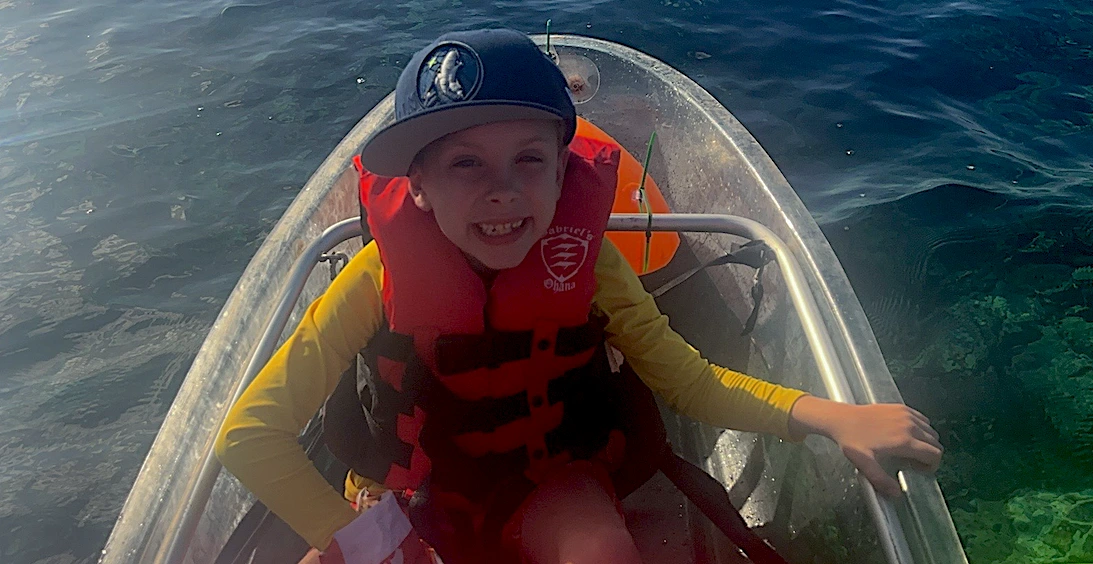
Becky and Andy say one of their 9-year-old son Jase’s favorite things to do lately is to show them how much mud he got on his white baseball pants. The dirtier they are, the prouder he is. Becky will grumble to him about washing them, but really, she’s grateful.
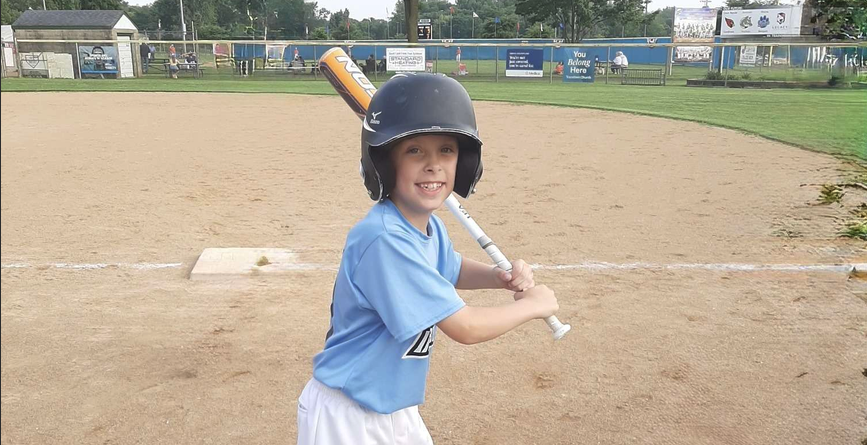
Jase’s muddy pants, his socks balled up in the basement, his sweatshirts thrown on the stair railing, his baseball glove by the patio door – it’s all evidence that Jase is feeling well. And after Jase’s brain tumor diagnosis in November of 2024, feeling well is something Jase and his family never take for granted.
Jase’s muddy pants are possible because of a clinical trial – a trial that is the culmination of research that’s been underway since before Jase was even born.
A Diagnosis With Few Options
The first signs showed up on a freezing Monday morning. Becky had dropped Jase off at school when, less than an hour later, she got a call that Jase had thrown up and said he was dizzy. At first, Becky figured Jase had a concussion - he’d taken a rock-solid snowball to the head while playing with a neighbor over the weekend. But things started to get worse alarmingly fast.
“By the time I brought him to the pediatrician, which was two hours later, he couldn’t walk,” Becky said. “The pediatrician took one look at him and said, ‘Take him to Children’s.’”
Becky and Jase rushed to the emergency room at Children’s Minnesota, where a CT scan revealed a brain tumor in Jase’s brainstem. The tumor was causing a buildup of pressure in Jase’s brain.
After multiple surgeries to relieve the pressure, a biopsy confirmed the type of tumor - Diffuse Intrinsic Pontine Glioma, a deadly form of cancer in kids. Most children diagnosed with DIPG survive less than a year after diagnosis.
“We were gutted when we learned what the diagnosis actually meant. I just remember feeling like they had to be wrong,” Becky said. “Being told there is no cure or real treatment for your child is devastating. No parent should be told to go home and make memories.”
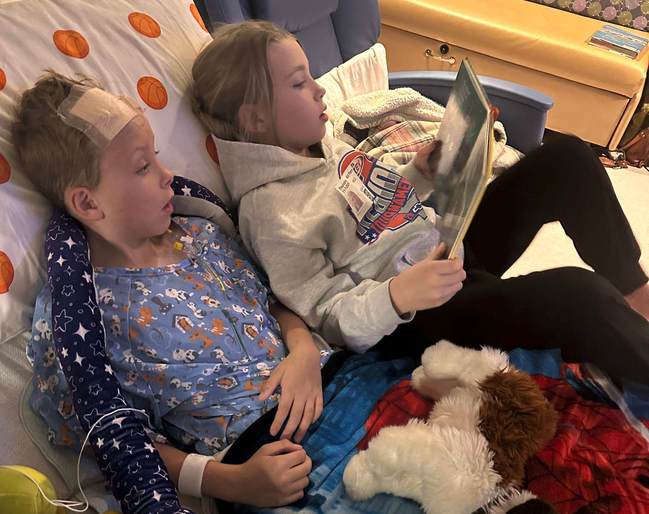
Jase and his care team moved forward with radiation to shrink the tumor. Radiation isn’t a cure for kids with DIPG - the most it can do is shrink the tumor, lessen a child’s symptoms, and give them more time. But that time comes with trade-offs. Jase experienced constant nausea, which made eating difficult. Radiation also caused fatigue, which sometimes held Jase back from doing the things he loves, especially playing baseball and basketball with his friends.
Becky and Andy knew that all radiation could do was buy them time. What they didn’t know was that for nearly two decades, just a few miles down the road, researchers had been slowly developing something that could do more.
A Trial Two Decades In The Making
Years before Jase was even born, Drs. Michael Olin and Christopher Moertel were using a grant from Children’s Cancer Research Fund to study the protective outer layer that certain brain tumors use to shield themselves from treatments like chemotherapy and radiation. When Jase was born in 2017, Olin was testing a peptide that would “turn off” the tumor’s shield in pet dogs. Jase was 3 when the FDA approved the drug for human use.
And just months after Jase was diagnosed with DIPG, a CCRF-funded clinical trial opened at Children’s Minnesota to test a first-of-its-kind therapy for children with Jase’s type of tumor.
The clinical trial, co-led by Drs. Anne Bendel and Maggie Skrypek, is the first of its kind for kids with DMG (a category of brain tumors that includes DIPG). The trial tests a treatment that acts as a one-two punch to this kind of brain tumor - a peptide that took decades to create breaks down the barrier a tumor uses to shield itself from damage, while a vaccine revs up the immune system to fight the tumor.
Jase enrolled as the trial’s very first patient. The trial’s ultimate goal is something that wasn’t possible just a few years ago: cure kids with DMG.
“Through this study, our hope is that we’re going to cure these patients,” said Dr. Bendel. “But in the process, we’re going to learn more about how the immune system reacts to the vaccine and then tweak it in a subsequent study to make it even more effective.”
Time to Be a Kid
Because CCRF donors kept funding this research at every stage, from the first lab experiments to the trial itself, Jase had somewhere to turn when standard treatment wasn’t going to be enough.
For Jase, this trial means treatment every other month: an MRI and bloodwork one day, then two days of treatment at the clinic. Treatment days are still hard, and Jase will tell you plainly that needles hurt. His care team has gotten good at distractions - one nurse even put on a hot dog costume once to get a laugh out of him. MRIs are scary, but Jase looks forward to Chick-fil-A on the way home. After treatments, he usually needs only a couple of hours of rest before he’s back to himself. In between, he’s just doing kid things. It’s now been over two years since his diagnosis.
“Ask any parent, and they’ll say, ‘All I want is time,’” Dr. Moertel, one of the lead researchers who developed the peptide that Jase’s treatment hinges on, said. Giving children with incurable cancers more time, without taking away from how they spend it, is the goal of this trial.
Research that Keeps Pace With Kids
In Spring 2026, Jase pitched his first season of kid-pitch baseball. He plays baseball and basketball, goes to school, and cheers on his favorite Minnesota sports teams, just like his friends.
“This trial is giving families more time, yes,” Dr. Moertel said. “But it’s also allowing kids to not appear different from their peers. Being included, being able to keep up – even when a child still has cancer, that makes everything feel a little less heavy.”
Jase’s latest MRI shows his tumor is stable. No one can promise how long that will last - his care team is watching closely. Becky feels this uncertainty acutely. She’s had to tell Jase’s three older siblings that even though he looks fine now, nobody knows what comes next.
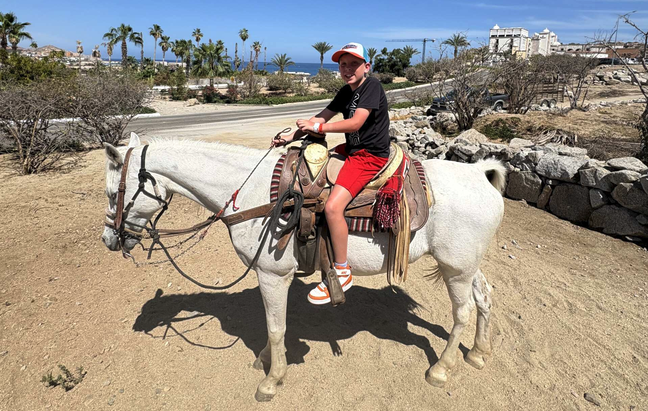
That’s why Jase’s parents are determined to share his story - they want people to understand how little funding childhood cancer research gets.
“Before we were in it, I was under the impression that federal funding covered cancer research," Becky said. In reality, that’s far from true - a majority of childhood cancer research funding comes from charities, nonprofits, and other non-government sources. For rare cancers like DIPG, a significant portion of research funding is raised by families who have been affected themselves.
Research like this only moves as fast as it’s funded. For nearly two decades, CCRF donors supported each step: the early lab experiments, the work to turn a discovery into a treatment, and now the trial itself. That steady support is why Jase’s trial exists.
The same is true of what comes next. The next treatment for rare brain tumors, and for other hard-to-treat cancers, is being worked on in a lab right now. How quickly it reaches a child depends on whether donors keep funding it. What we do now dictates what the next child will find waiting for them when they’re diagnosed. Becky and Andy want it to be a cure.
“I don’t want them to hear there’s nothing that can be done,” Becky said. “When you Google DIPG, all you see is the bad - no cure, no real treatments. We are so grateful that there are incredibly smart people working towards a goal we never knew we’d need.”