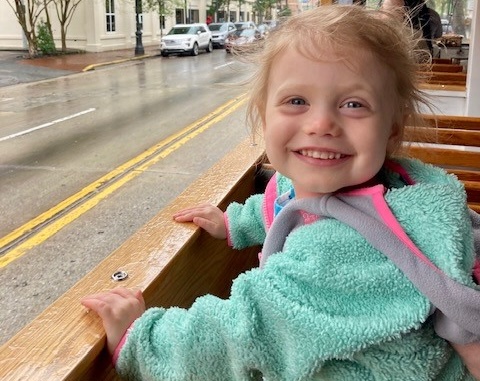
Christina feels like pinching herself as she picks her 7-year-old daughter, Ella, up from dance class. Watching Ella skip to the car, giggling and making silly faces with friends, feels like a miracle – because it is.
Ella, a survivor of a rare and aggressive subtype of acute myeloid leukemia called M7-AML, wasn’t expected to reach her third birthday. Early on, the odds were stacked against her. But she’s been beating those odds every day – starting kindergarten, running on the soccer field and learning to read.
She’s here because for years, someone had been working to change those odds.
Donor-funded research is making Ella’s childhood possible.
Before Ella was even born, Dr. Soheil Meshinchi was in his Fred Hutchinson Cancer Center lab in Seattle, working on a potential new treatment for AML. He was one of only a handful of researchers at the time working on Ella’s specific subtype, and his goal was to create a less harsh, more effective treatment for kids whose AML returned after their initial treatment.
Ella’s parents discovered Dr. Meshinchi when they went searching for treatments that could save their daughter if her cancer were to come back after initial treatment. They learned he was developing a revolutionary “one-and-done” treatment for kids with AML – a therapy designed to activate a child’s immune system so it can eradicate cancer cells once and for all. This treatment would offer the possibility of a single, targeted treatment instead of years of toxic chemotherapy. And if Ella’s cancer comes back, it could save her life.
But promising research, especially this rare and hard-to-treat type of AML, doesn’t move forward on hope alone.
“Since the number of patients seen in a year (with this kind of AML) is so small, there’s no interest from drug companies to support this,” said Dr. Meshinchi. “The biggest hurdle to this work is financial.”
So, Ella’s family teamed up with Children’s Cancer Research Fund to help advance Dr. Meshinchi’s work and raised over $1.3 million to help launch his clinical trial. But the organization didn't stop there.
CCRF connected Dr. Meshinchi with a network of committed donors, coordinated fundraising efforts across families and foundations, and ensured his research had the sustained support it needed to move from the lab to patients. Without that infrastructure, this trial might still be waiting for funding. In April 2025, the trial enrolled its first pediatric patient.
 “Because of the support from CCRF, foundations and families, we’ve been able to really bring this from target discovery to a clinical trial in record time,” Dr. Meshinchi said. “This is as close to a Holy Grail of cancer therapy that I think we’ve ever come.”
This is the reality of childhood cancer research – talented researchers with bold ideas set out to save kids like Ella, but they’re up against roadblock after roadblock. Data is scattered between institutions. Funding is inconsistent. Promising science peters out, and kids with cancer face delays they can’t afford. Parents sit beside hospital beds while they set up donation drives, calling donors, and refusing to let research stall. It’s not sustainable.
That’s why CCRF is creating the Pediatric AML Collaborative, a national collaboration of families, foundations, clinicians, and researchers dedicated to saving the lives of kids with AML.
The Pediatric AML Collaborative will…
- Unify previously fragmented fundraising efforts – because families shouldn’t carry the burden of fundraising for their child’s survival.
- Identify and fund the most promising research, making sure donor funds go where they can do the most good.
- Help researchers move faster and scale their breakthroughs, getting lifesaving treatments to more kids.
At CCRF, we’re working to fund the next wave of high-impact AML research. This is our chance to change how research moves, to create a funding pipeline that is coordinated, strategic, and unstoppable.